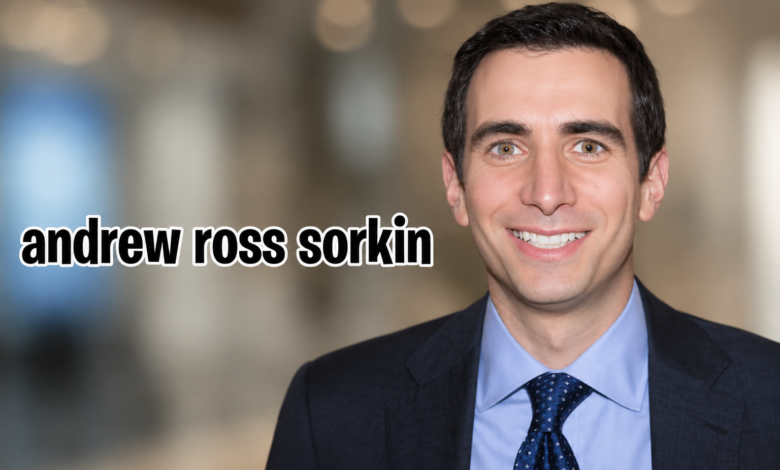
Andrew Ross Sorkin: The Powerful Journey of a Financial Journalism Icon and His Influence on Wall Street

Introduction
Andrew Ross Sorkin is one of the most recognizable names in American financial journalism. Known for his ability to explain complicated business stories, Wall Street developments, corporate deals, and financial crises, he has built a powerful career across newspapers, digital media, television, books, and entertainment.
His professional journey demonstrates how early ambition, strong reporting skills, and deep knowledge of business can create a long-lasting media career. At the same time, the financial world he covers is often complex and controversial, meaning his work frequently examines both positive achievements and negative consequences within corporate America.
Andrew Ross Sorkin is best known for his work with The New York Times, his creation of DealBook, his role as a co-anchor on CNBC’s Squawk Box, and his bestselling books about major financial events. His career has also extended into television production through the successful drama series Billions.
Andrew Ross Sorkin Quick Bio
| Information | Details |
|---|---|
| Full Name | Andrew Ross Sorkin |
| Profession | Journalist, author, television personality and producer |
| Nationality | American |
| Birthplace | New York City, United States |
| Date of Birth | February 19, 1977 |
| Education | Cornell University |
| Degree | Bachelor of Science in Communication |
| Known For | DealBook, Squawk Box, Too Big to Fail, Billions and 1929 |
| Career Began | 1995 |
| Major Professional Affiliations | The New York Times, DealBook and CNBC |
| Spouse | Pilar Queen Sorkin |
Early Life of Andrew Ross Sorkin
Andrew Ross Sorkin was born on February 19, 1977, in New York City, United States. Growing up in one of the world’s most important financial and media centers may have provided an environment where business, journalism, and public affairs were highly visible.
From an early age, Andrew Ross Sorkin developed an interest in journalism. His career began unusually early, and his professional connection with The New York Times started while he was still in high school. This early beginning became an important foundation for his future success.
His career story is positive because it shows the value of determination and preparation. However, beginning a career in highly competitive journalism also requires significant discipline, because financial reporting demands accuracy, speed, and the ability to understand complicated information.
Education and Academic Background
Andrew Ross Sorkin attended Cornell University and graduated in 1999. He earned a Bachelor of Science degree in Communication, developing academic knowledge while also gaining practical experience as a journalist.
During his university years, he continued writing for The New York Times. This combination of education and real-world reporting allowed him to develop professional experience before completing his degree.
His academic journey is an example of how education can support a media career. At the same time, a university degree alone does not guarantee success in journalism, and Sorkin’s early reporting experience played an important role in building his professional identity.
The Start of Andrew Ross Sorkin’s Career
Andrew Ross Sorkin began writing for The New York Times in 1995 while he was still in high school. This gave him an exceptionally early introduction to one of the world’s most influential newspapers.
After graduating from Cornell University, he continued his professional career with The New York Times. His early work included reporting on mergers and acquisitions, an area that eventually became one of his major areas of expertise.
Financial journalism can be challenging because corporate transactions often involve complex negotiations, confidential information, and rapidly changing developments. Andrew Ross Sorkin built his reputation by focusing on these difficult areas and helping audiences understand their wider significance.
Andrew Ross Sorkin and The New York Times
The relationship between Andrew Ross Sorkin and The New York Times has been central to his career. Through the newspaper, he developed into a prominent journalist covering Wall Street, corporate America, business leaders, and major financial developments.
His reporting has included coverage of mergers, acquisitions, financial institutions, and moments of economic crisis. His work helped establish him as a journalist with significant knowledge of the relationship between powerful companies, financial markets, and government policy.
Business journalism can create an important public service by making powerful institutions more understandable. However, financial stories can also be difficult for ordinary readers because of technical language and complex economic concepts. One of the strengths of Andrew Ross Sorkin’s work has been his ability to present major financial stories in a more accessible way.
DealBook: A Major Professional Achievement
The Creation of DealBook
Andrew Ross Sorkin founded DealBook in 2001. The project became an important platform for business journalism, focusing on Wall Street, corporate transactions, business leadership, financial markets, and the connection between business and politics.
DealBook expanded beyond traditional written reporting and developed into a broader media platform. Its work includes journalism, interviews, newsletters, and major events involving influential figures from the worlds of business and finance.
The Influence of DealBook
The success of DealBook helped strengthen Andrew Ross Sorkin’s position as an important voice in financial journalism. The platform created a space where major business developments could be discussed and analyzed for professional audiences and the wider public.
The business world can sometimes appear distant from ordinary life, but corporate decisions can influence employment, investment, technology, prices, and the wider economy. DealBook has focused on helping audiences follow these important developments.
CNBC and Squawk Box
Andrew Ross Sorkin expanded his career into television through CNBC. He became a co-anchor of Squawk Box, one of the network’s best-known business programs.
His television role allowed him to bring his journalism and financial knowledge to a larger audience. Through interviews and live discussions, he has covered important issues involving markets, companies, economic policy, and influential leaders.
Live television also presents challenges because major financial news can change quickly. Journalists must respond to new information while maintaining accuracy and providing useful context.
Andrew Ross Sorkin as an Author
Too Big to Fail
One of Andrew Ross Sorkin’s most important books is Too Big to Fail, which examined the 2008 financial crisis. The book focused on the dramatic events surrounding Wall Street institutions and government efforts to prevent a wider economic collapse.
The book became highly influential and later received the Gerald Loeb Award for Best Business Book. Its success also led to an HBO film adaptation, with Andrew Ross Sorkin serving as a co-producer.
1929
Andrew Ross Sorkin continued his interest in financial history with 1929: Inside the Greatest Crash in Wall Street History—and How It Shattered a Nation, published in 2025.
The book examines the Wall Street Crash of 1929 and its consequences. By exploring another major financial crisis, the work reflects Sorkin’s continuing interest in understanding how financial decisions and economic events can affect society.
Television Production and Billions
Andrew Ross Sorkin also became a co-creator of the television drama Billions. The series explores wealth, hedge funds, corporate power, legal conflict, and the competitive world of high finance.
This project allowed Andrew Ross Sorkin to bring his understanding of Wall Street into scripted entertainment. It also demonstrated that professional knowledge gained through journalism can be used successfully across different forms of media.
The entertainment industry and financial journalism are very different fields, but Sorkin’s career shows how specialized knowledge can create opportunities beyond traditional reporting.
Career Achievements and Professional Influence
Andrew Ross Sorkin has built a career that includes journalism, broadcasting, writing, digital media, and television production. His ability to work across different media formats is one of the strongest features of his professional journey.
His work has also received major professional recognition, including the Gerald Loeb Award and an Emmy Award. These achievements reflect his contributions to business journalism and television.
His career is particularly notable because he has remained focused on the intersection of business, finance, and public life while continuing to adapt to changing forms of media.
The Legacy of Andrew Ross Sorkin
The legacy of Andrew Ross Sorkin is closely connected to his contribution to modern financial journalism. He has helped make major stories about Wall Street and corporate America more understandable to wider audiences.
Through DealBook, The New York Times, CNBC, books, and television production, he has created a professional presence across several major media platforms.
His work also demonstrates that financial journalism is not only about reporting numbers and corporate announcements. It can involve explaining how decisions made by powerful institutions affect economies, governments, businesses, and individuals.
Conclusion
Andrew Ross Sorkin has built a powerful and influential career through journalism, financial reporting, television, writing, and media production. From his early work with The New York Times to the creation of DealBook and his role on CNBC’s Squawk Box, he has remained closely connected to the changing world of business and finance.
His career includes major achievements, bestselling books, award-winning work, and successful television projects. The positive side of his story is his ability to make complex financial subjects understandable, while the negative side of the world he covers often involves financial crises, corporate conflict, and economic uncertainty.
Andrew Ross Sorkin remains an important figure in the media landscape because his work connects journalism with the real-world forces shaping Wall Street, corporate America, and the global economy.
Frequently Asked Questions
Who is Andrew Ross Sorkin?
Andrew Ross Sorkin is an American journalist, author, television personality, and producer. He is known for his work with The New York Times, DealBook, CNBC’s Squawk Box, Too Big to Fail, and Billions.
What is Andrew Ross Sorkin famous for?
Andrew Ross Sorkin is famous for financial journalism, covering Wall Street and corporate America. He is also known as the founder of DealBook and as a co-anchor of CNBC’s Squawk Box.
When did Andrew Ross Sorkin start his career?
Andrew Ross Sorkin began writing for The New York Times in 1995 while he was still in high school.
Where did Andrew Ross Sorkin study?
Andrew Ross Sorkin attended Cornell University and graduated with a Bachelor of Science degree in Communication.
What is DealBook?
DealBook is a business and financial news platform founded by Andrew Ross Sorkin. It focuses on Wall Street, corporate transactions, business leaders, financial markets, and the relationship between business and politics.
What books has Andrew Ross Sorkin written?
Andrew Ross Sorkin is known for Too Big to Fail, which examines the 2008 financial crisis, and 1929, which explores the Wall Street Crash of 1929 and its impact.
Is Andrew Ross Sorkin involved in television?
Yes. Andrew Ross Sorkin is a co-anchor of CNBC’s Squawk Box and is also a co-creator of the television drama Billions.
What is Andrew Ross Sorkin’s legacy?
Andrew Ross Sorkin’s legacy is his contribution to modern financial journalism. His work has helped audiences understand complicated subjects involving Wall Street, corporate America, financial crises, and economic change.